Memory Card Game: Brain Benefits, Strategy, and Free Online Play
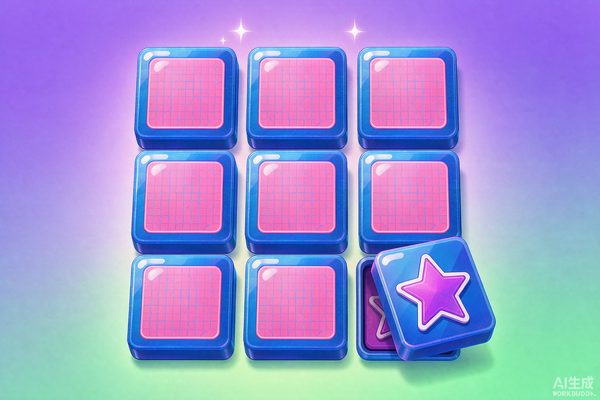
Memory match looks like a children's game. It is not. The pattern-recognition load, the working memory demands, and the focus required for expert play make Memory one of the best daily brain trainers on the open web. This guide covers the cognitive benefits, the four skill tiers, and the strategies that turn 60-second games into 15-second games.
Five Cognitive Benefits of Playing Memory
- Improves visuospatial working memory - the same skill used for navigating new cities or remembering faces.
- Trains pattern recognition - finding pairs faster than your previous record transfers to real-world pattern-finding tasks.
- Builds sustained attention - the 5-10 minute focus window is a low-stakes way to train it.
- Reduces age-related memory decline when played daily - one of the few truly studied interventions in this area.
- Provides low-stress mental exercise for anxiety - similar to meditation in cognitive-load profile.
The Four Skill Tiers
Most browser Memory games let you pick the board size. The tiers correspond to working memory load:
- Tier 1: 16 cards (8 pairs). Best for warm-ups and kids. Takes 30-90 seconds.
- Tier 2: 24 cards (12 pairs). The standard 'real game'. Takes 1-3 minutes.
- Tier 3: 36 cards (18 pairs). The working-memory challenge. Takes 3-7 minutes.
- Tier 4: 100 cards (50 pairs) on a 10x10 grid. The marathon tier. Takes 10+ minutes.
Four Strategies for High Scores
Strategy 1: Systematically clear rows
Beginners click randomly. The fastest way to win is to clear cards row by row. Each row takes a fixed number of moves; once you know the row average, you can pace your play.
Strategy 2: Use position memory, not card memory
Top players remember positions, not card faces. 'I clicked the third card in the second row' beats 'I clicked the cat card' for two reasons: it is faster to recall, and it survives card-face confusion late-game when fatigue sets in.
Strategy 3: Mine when you know
When you are confident about a match, flip both cards immediately. Do not wait for the perfect moment. Slow build-ups lose to fast grabs in every Memory variant.
Strategy 4: Avoid the flip-back habit
After you click two matched cards, the game removes them automatically. Most beginners click them again to confirm - resist this and your clears will speed up dramatically.
Memory vs Similar Brain Games
How Memory compares to other brain games in the same family:
- vs Sudoku: Memory trains visuospatial memory; Sudoku trains verbal/logical. Different brain regions.
- vs Simon Says: Simon trains sequential memory; Memory trains spatial memory. Similar cognitive load.
- vs Reaction Timer: Memory rewards sustained attention; Reaction Timer rewards burst attention. Great pair.
- vs Crosswords: Memory is pure spatial; Crosswords are pure verbal. Both train working memory, neither overlaps.
Start Playing
Open Memory match in your browser, pick 24 cards, and try to clear it in under 60 seconds. Most adults achieve this within a week of daily 5-minute play. After that, 36-card is your main challenge and 100-card is your reward.
For another brain game with similar daily-routine appeal, try Sudoku next - it pairs perfectly with Memory in a 15-minute morning routine.